
My pension isn't enough. I can't stop working.
One in three people in Switzerland expects to need additional income in retirement. This is according to Swiss Life’s new 2026 Self-Determination Barometer. What the study reveals about retirement—and why working in old age has gone from being the exception to the norm.
Retirement was long considered a clear-cut milestone. At 65, it’s over; from then on, the AHV and pension fund kick in. That picture has begun to crack. For one thing, because many people are taking a hard look at the numbers. For another, because more and more people don’t want to stop working at all.
What the study shows
In July 2026, Swiss Life, in collaboration with the Bilendi Institute, surveyed 1,000 people in Switzerland between the ages of 18 and 79. The results were published on October 5, 2026. The following figures are particularly relevant to the topic of working in old age:
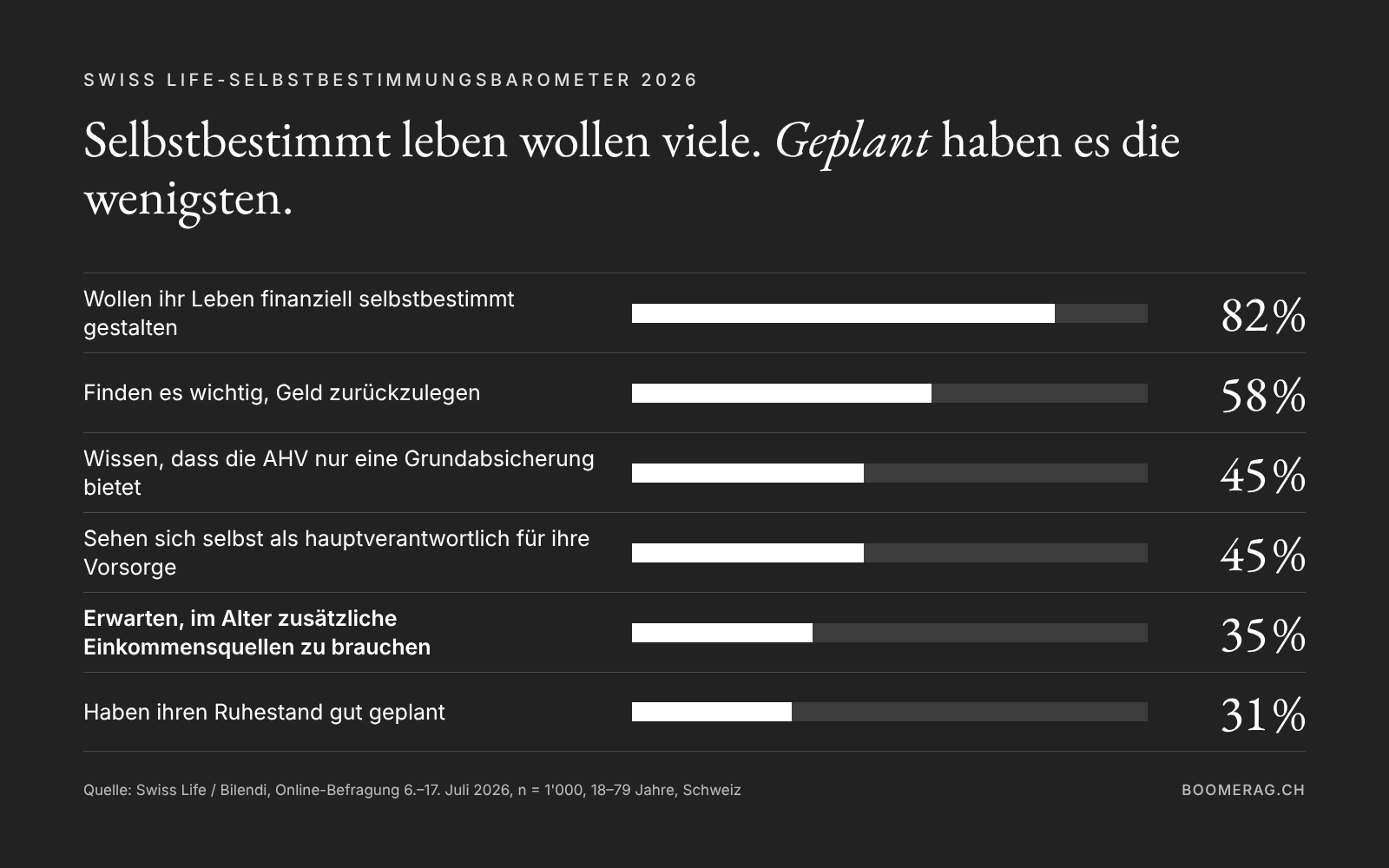
The percentage of those who feel responsible for themselves has risen by 4 percentage points compared to last year. Only 22% rely on the government to support them when they face difficulties.
The Gap Between Aspiration and Reality
82% want to live with financial independence. However, only 44% actually feel that way. In 2019, that figure was 51%. The gap between aspiration and reality is thus 38 percentage points.
This is consistent with the fact that only 31% have planned their retirement well, and 28% would like to have more financial knowledge. So many people know that the numbers don't quite add up. Very few have a plan for it.
There is also some good news. Among retirees, financial confidence has risen by 8 percentage points to 40%. Across all age groups, 58% expect their financial situation to improve over the next ten years.
Work as an Additional Source of Income
Where is the extra money supposed to come from? The most obvious answer is neither an inheritance nor a lottery ticket. It's work.
On our platforms, Rent a Rentner and Hire a Rentner, more than 4,000 retirees offer their skills. They work as handymen, gardeners, bookkeepers, drivers, or mentors for both individuals and businesses. Some do it for the money, most for the sense of purpose, and almost all because they want to decide for themselves how much to work and what to do.
That is precisely where the connection to the study lies. People who work in old age are not just supplementing their retirement benefits; they are determining for themselves what their retirement will look like.
From an Exceptional Case to the Norm
When we launched Rent a Rentner 17 years ago, working after retirement was still something of a novelty. We had to work hard to convince both our clients and the retirees themselves.
Today, it has become the norm. Retirees who continue to work no longer have to justify their decision. We helped bring about this shift in thinking.
What This Means for Businesses
This makes the 60+ generation doubly attractive to companies.
Target audience: She has strong purchasing power, is well-informed, and is thinking about her future. Anyone offering services related to retirement planning, finances, housing, or health is meeting a growing need for planning and guidance.
As workers: One-third expect to need additional income in retirement. At the same time, many industries are facing a shortage of skilled workers. Experienced retirees can fill this gap, working flexibly and on a project basis.
Both of these goals can only be achieved by addressing them in the right way. Anyone who labels older people as “seniors” or speaks to them using clichés about cruises and park benches will not reach them. The 60+ generation wants to be addressed as equals—as active, self-determined individuals.
Conclusion
The Swiss Life Barometer confirms what we have been observing for years: People want to be in control of their own lives in old age, and many know that a pension alone is not enough to make that happen. Work is the bridge between this desire and reality.
Working in old age isn't just a stopgap measure. It's the most modern form of retirement planning.
About the study: Swiss Life Self-Determination Barometer 2026. Online survey conducted by Swiss Life and Bilendi, July 6–17, 2026, involving 1,000 people aged 18 to 79 in Switzerland.